Showing posts with label Globalisation. Show all posts

Narborough Road in Leicester

Narborough Road in the late 40s
Narborough Road in Leicester was named the most diverse street in Britain by academics. The shooting street has shop owners from 23 different countries including Zambia, Uganda and Tanzania. There are also shopkeepers from eastern European counties, a fish and chip shop boss from Hong Kong and a bookmakers ran by a Canadian couple. Researchers have named it the most diverse street in the UK after discovering the owners of its 220 shop units come from 23 different counties. Members of the Braunstone History Group have spoken about how the area has changed over the years. Helen Caterwell said: 'Narborough has changed from being aa residential area to lots of shops over the years. We've seen different communities come in from different nationalities and I think it's actually quite and interesting area to be in because of the diversity of people.'

Academics at London School of Economics (LSE) admitted they were amazed at the number of nationalities when they visited the road in a suburb of south west Leicester. Dr Suzanne Hall, lead researcher, said 'What is interesting is about Narborough Road is that it's not a Little Italy or Chinatown'. 'It is the world in a microcosm, all these people, from all these different place, different cultures, living cheek by jowl, working wth each other and living in harmony. It is really an incredible array of nationalities in one place.'

Narborough Road as it is today 
The countries represented on the steer are Britain, Uganda, Lithuania, Canada, Zimbabwe, Somalia, Iran, China, Tanzania, Poland, India, Cameroon, Turkey, Afghanistan, Kenya, Pakistan, Zambia, Jamaica, Kurdistan, Iraq, Thailand, Sri Lanka and Malawi.

Tajinder Reehal, 55, who was born in Nairobi, Kenya and runs Scorpion smoking shop said: 'I've seen the street change in the past 16 years. It's come alive. More bars, more restaurants. It's much more vibrant. I've seen the different nationalities come and go, too. Lots of Polish and Eastern Europeans now, but before that, it seemed to be mainly Turkish and Spanish.'
'I like it. It gives the area its identity. It feels cosmopolitan. You don't have to go into Leicester if you live here. It's all on your doorstep.'

Researchers found that shopkeepers on the street also trade skills with each other. The Canadian couple who run the bookmakers get a free haircut or free meal at a restaurant because they help other owner fill in the forms.

Lloyd Wright, who is half English and half Polish and runs a music shop said: 'There are people here from all over the world, but there's no tension. It's a very relaxed atmosphere. I'm proud to tell people this is wheel I'm from.'

I think that Narborough Road is the perfect example of an ethnoscape. The road shows the effects that migration of people across cultures and borders has led to. This is a cultural landscape that you can read from the shops and the different people who work on the street. It is a mini community of people from a variety of cultures working in harmony.

Why is Leicester so diverse? 
The city became four times lager as people moved to Leicester during the industrial revolution to find work in the shoe and textile mills. After Indian population grew in the post-war years, the authorities took out adverts to discourage Ugandan Asians from moving there in 1972 during Idi Amin's dictatorship. But the adverts have been heavily criticised by community leaders and they actually had the opposite effect encouraging the group to come to the city.
The 2011 census showed that less than half of Leicester's population described themselves as White British. The census reported: 'Of the 110,843 born abroad, 36% arrived since 2004.'

See the article written by the Daily Mail here: http://www.dailymail.co.uk/news/article-3432300/How-things-used-Evocative-pictures-street-named-diverse-Britain-looked-years-ago.html
http://www.dailymail.co.uk/news/article-3429838/Most-multi-national-high-street-Britain-boasts-business-owners-23-different-countries.html

Dr Suzanne Hall (LSE): http://www.lse.ac.uk/researchAndExpertise/Experts/profile.aspx?KeyValue=s.m.hall@lse.ac.uk

Globalisation and Glocalisation


Undeniably, the world is becoming more global. In this homogenous global culture all cultural differences are disregarded. What may be considered offensive in Middle Eastern cultures does not exist anymore and typical Western advertising is no longer the norm for global brands. Homogeneity promotes an ever-increasing world economy because anyone/everyone can be targeted through the same advertisements and marketing campaigns. A successful example of glocalisation (when a brand roles out a product which appeals globally) is when Disney opened a theme park in Europe, then called Euro Disney (Disneyland Paris). The theme park struggled to make a profit in the first few years and appeared to be a huge mistake for the American company. The mistake was to force the US concept of the park to Europeans, who were everything but receptive. When changing the name Euro Disney to Disneyland Paris, the Walt Disney Company started to implement glocalisation practices. The main changes were "cutting the price; turning shows and settings into a French style; change the food menus and eating habits; and change of employees customs and labour policies." These changes turned out to be a smart move.


The Disney Company
Revenue (2014): US$ 48.813 billion
Number of employees (2014): 180,000
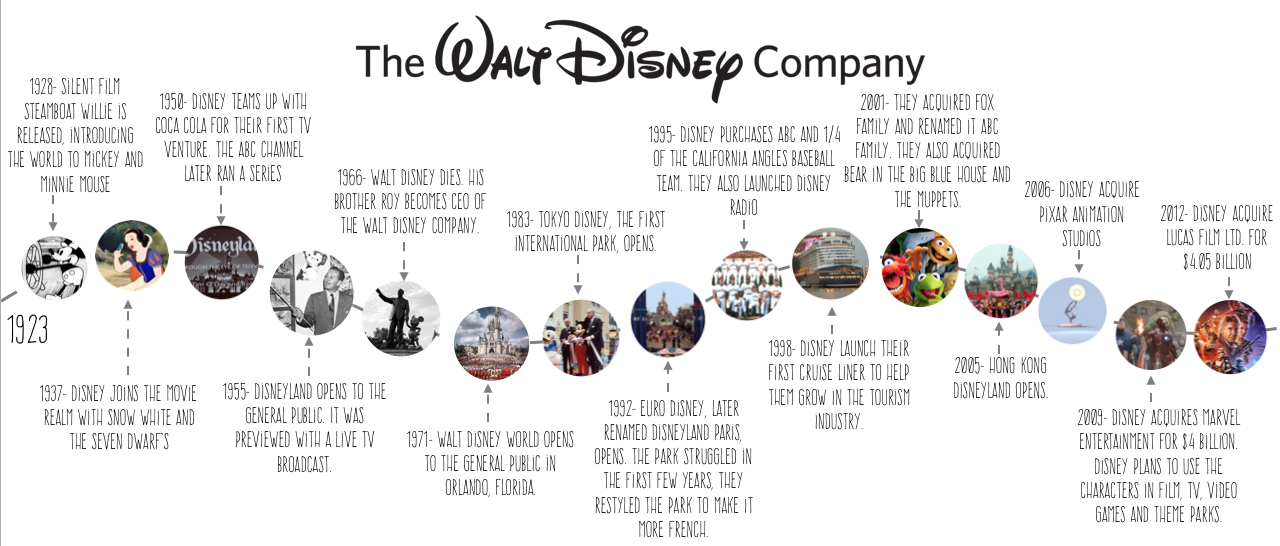
The Disney Company was established in 1923 by Walt Disney and Roy O. Disney. The company rapidly began to expand and in the years to come has grown exponentially. Steamboat Willie was released in 1928, introducing the world to Mickey and Minnie Mouse. It established the image that the Disney Company now relies upon. Disney stepped into the movie realm in 1937 with Snow White and the Seven Dwarfs. The company then began to expand beyond film and television by opening a theme park. Disneyland opened in 1955, and then in 1971 Walt Disneyland Resort opened in Orlando, Florida. In the 1980s the company began to expand internationally due to its success in the US. The first international park, Tokyo Disneyland, opened win 1983, a decade later they agreed to build Euro Disneyland- later renamed Disneyland Paris.
In 1995 they purchased ABC and a fourth of the California Angels Baseball team. They continued to expand through opening their own radio station: Radio Disney. To increase their audience to include sports fans, they launched the ESPN magazine and opened their wide world of sports.
Disney launched their first ship from the cruise line in 1998, to grow in the industry of tourism. In 2001 the acquired Fox Family and renamed it ABC family. They also acquired rights to The Muppets and Bear in the Big Blue House.
Hong Kong Disneyland officially opened in 2005. 2006 saw Disney acquire Pixar Animation Studios and 2009 saw them acquire Marvel Entertainment. Marvel cost Walt Disney $4 billion (£2.5 billion). Disney planned to use the franchises characters in film, TV, video games and theme parks. The acquisition of Marvel brought Disney a new audience. Disney's Chief Executive Bob Iger, said "Marvel has a treasure trove" of property that "transcends gender, age, culture and geographical barriers". David Joyce, a media analyst and stockbroker Miller Taback, said "this helps give Disney more important exposure to the young male demographic that the have sort of lost some ground with in recent years". (Andrew Clark, The Guardian [April 2009])
2012 Marvel Studios film The Avengers became one of the highest grossing films of all time after grossing $1.520 billion at the worldwide box office.
More recently in 2012, Disney completed its acquisition of Lucas Film Ltd. and gained the rights to the Star Wars Franchise. The company says the transaction included a cash payment of $2.21 billion and just under 37.1 million Disney Shares. The Star Wars franchise is estimated to be worth over $30 billion. Star Wars Episode VII was released in December 2015 and has become the highest grossing film of all time at the domestic (US) box office. Episode VIII is currently moving into production for a December 2017 release [as of Feb 2016] and Rogue One: A Star Wars Story (due for release in December 2016) is moving into post-production. Other films including Episode IX and a Han Solo anthology are also planned. (LA Times).